



Artificial intelligence and dealerships: why technology alone is not enough

From enthusiasm for AI to the search for concrete results
In recent years, Artificial Intelligence has become one of the most discussed topics within the automotive industry. After an initial phase characterized by announcements, promises and experimentation, the market is finally entering a more mature phase, as found at the recent Automotive Dealer Day 2026, staged at the Veronese exhibition center. Today, leading technology companies are integrating AI within CRM, DMS and customer management platforms with the goal of automating many operational activities that absorb time and resources without generating direct value for the customer.
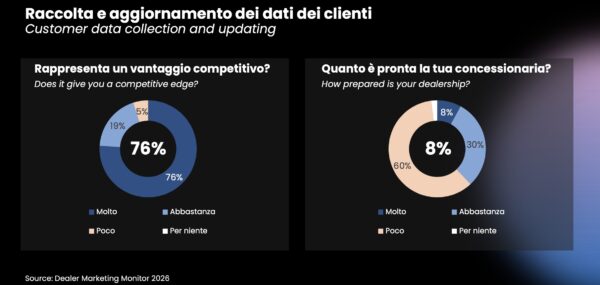
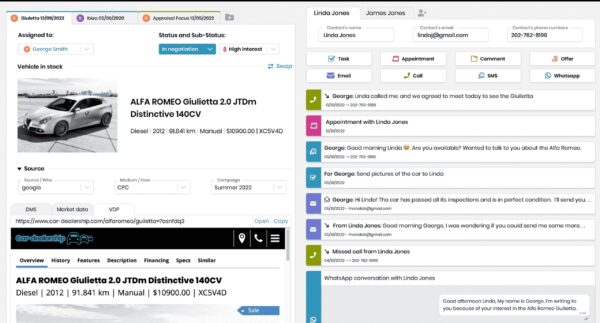
Lead management, customer care, appointment management, sales follow-up and complementary activities in after-sales are just some of the areas in which new technologies are already producing measurable results. Indeed, the most advanced integrations-for example, what Spanish start-up Walcu is proposing-allow intercepting requests from different channels, automatically classifying them, suggesting consistent responses, and directing customers to the most appropriate department or figure. In some cases, it is even possible to go as far as automatically scheduling appointments or reactivating inactive customers through customized campaigns, not forgetting quick responses to emails, sending quotes, documentation, brochures and more.
The real obstacle is not technology, but organization
Although the offerings available in the market today are more extensive and concrete than ever-and the multiple workshops staged at ADD26 show the incredible advancement of the field and the practical application of many solutions-our experience alongside distribution networks highlights a recurring critical issue. Many organizations continue to view AI as a technology project, when in fact it is first and foremost an organizational project. Technology can automate repetitive tasks, reduce response times and improve accessibility to services, but it cannot replace the need to define clear processes, precise responsibilities and consistent operating models.
The risk is that of introducing advanced tools within organizations that have not yet developed adequate procedures, skills and measurement systems to exploit them. This is where the gap is generated between what the market offers and what many realities actually manage to exploit.
Data, CRM and customer activation: the new competitive advantage
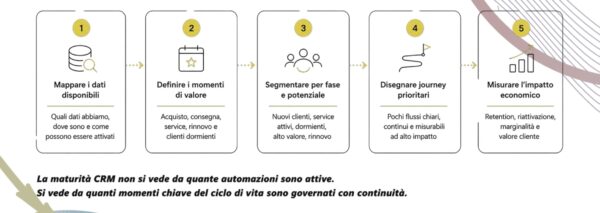
The real opportunity is not simply in usingAI, but in linking it to a customer relationship management strategy. Think about the activities that every organization should be able to manage in a systematic way: reminders for coupons and overhauls, lease and rental expirations, post-purchase and post-service follow-ups, recalls for maintenance campaigns, periodic communications, and loyalty activities. Individually they may seem like simple operations. Taken together, however, they represent one of the main factors influencing Customer Experience and Loyalty.
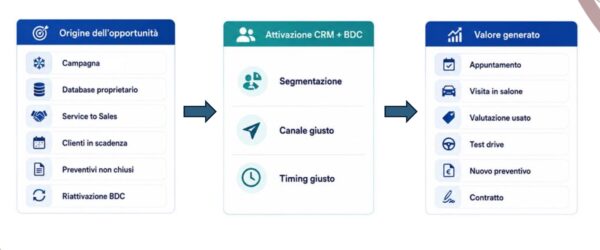
It is precisely in this context that the integration of CRM and Artificial Intelligence can generate high value. Analyzing thousands of master records, identifying business opportunities, activating personalized communications and supporting staff in daily activities becomes possible without increasing people’s operational load, as is the case in realities that today fail to automate these touchpoints. In fact, some platforms make it possible to query the management system and one’s CRM directly, as one would do with Chat GPT, Claude, Gemini and many other Chat AI systems: the DMS is transformed into the “database” to be analyzed, capable of returning output in real time, by-passing the huge timeframes that a similar activity would require of a single human operator.
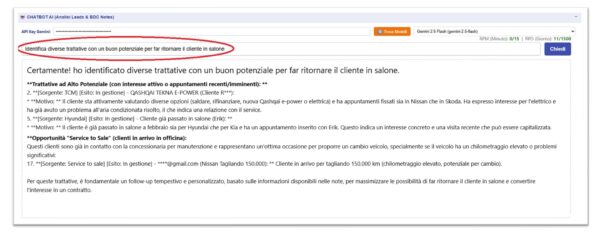
According to evidence shared by several practitioners in the field, organizations that adopt these tools in a structured way record tangible benefits in terms of speed of response, quality of service, recovery of inactive leads and overall team productivity. Data, therefore, should no longer be understood as a goal to strive for, but rather a sufficient condition without which information, which is increasingly the differentiating element of the most organized networks, cannot be built.
JET’s role: transforming technology into sustainable change
It is in this scenario that the role of JET fits. Our experience leads us to observe on a daily basis how important it is to accompany the introduction of new technologies with parallel work on processes, organization and skills. The goal is not to replace people, but to create an ecosystem in which technology and human capital work in a complementary way.
AI can gather information, classify requests, prepare leads, and support processes. Instead, people continue to do what generates the most value: understand customer needs, build trust and develop lasting relationships. For this reason, the question dealerships should ask themselves today is not whether to adopt AI, but how to integrate it within an organizational model capable of turning innovation into a real and sustainable competitive advantage.


I #dealer hanno a disposizione numerose leve strategiche per gestire i clienti, i dati disponibili e le relazioni da costruire. Hanno… Read more

Beyond the product: the central role of technology and ecosystems Auto China 2026 is much more than just a motor show:… Read more

Non coltivare la relazione con il cliente non è solo un tema operativo, ma una scelta strategica. Ogni #lead è un’opportunità… Read more