In these months of deep change, some forced and some probably just brought forward from a foreseeable future, people have started talking again about the New Normal, the new scenario that typically emerges from a major break, one that today is radically different from the last one that hit us, the financial crisis of 2007.
This time the new normal involves a fierce, deep and widespread change in our habits and our priorities. Above all, those linked to everyday travel, whether for work or pleasure, are set to change radically.
We are all already experiencing every day what this can mean for personal mobility: and for those working in the automotive sector, it is interesting to reflect briefly on the transition that both production and distribution chains are facing to win back the present and secure a sustainable, profitable future. The health emergency caused by Covid-19 has had an all-round impact: production, the components supply chain, sales, services, workers, customers.
It is essential to stress that the automotive sector is a strategic asset in industrialised countries, and especially in Italy, because of its fragilities and the high value of the know-how, quality and design held by companies of every size, often recognised on international markets as excellences of Made in Italy.
Today the car market is among the biggest gears driving the economy: in Italy it is worth 11% of GDP and carries considerable industrial and social weight, because the whole sector supports hundreds of thousands of families, with employment of around 258,000 people in total.
The whole sector is worth around 190 billion euros, with the components supply chain alone counting 5,700 companies; Italy is among the world’s largest exporters (for example, around 8% of the value of a German car is made up of Made in Italy components).
It is also the sector that invests the most in research and development in Italy today (1.7 billion, almost 19% of the national total), with a positive trade balance of almost 7 billion euros.
And Europe, in turn, is the area that invests the most in R&D in the world, with over 60 billion euros a year. Japan is second with 30 billion, ahead of the USA with 18.
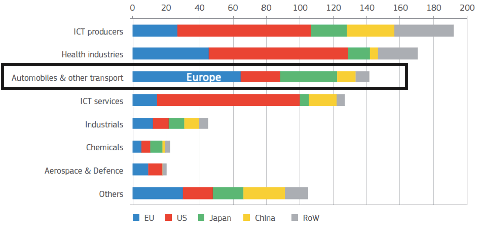
R&D investment by industry and geographical area (€ billion).
[Source: European Commission. The 2019 EU Industrial R&D Investment Scoreboard]
With these numbers in mind, and thinking about what we are living through now, we realise that the pandemic suddenly showed us that, in such a connected and volatile world, global production and distribution chains need to be efficient and lean, but at the same time must also be able to protect a company’s fragility from all these shocks, rediscovering the value of flexibility and the security of having different options, sometimes redundant, some remote, others that must necessarily use new technologies.
Smart working, or rather remote working, is no longer and not only a matter of corporate welfare: it must find a way to become strategic as a way to increase productivity and reduce costs, while keeping a positive impact on the community. The changes caused by the health emergency are affecting production processes, on the one hand accelerating the digitalisation of work already under way, and on the other bringing forward the need to rapidly develop and use eco-friendly mobility.
The factories that are reopening will not immediately be at full capacity; production is being restored gradually and must take into account the substantial freeze in sales.
This is where the delicate balance of demand emerges: upstream, the components supply chain, which builds the parts that make up cars, is pushing to be operational. Downstream, the networks, still essential to add value and reach the end customer everywhere, need existing customers and new prospects with whom to close deals so as not to come to a halt.
The impact of the New Normal on the end customer is already visible: video conferencing is becoming a habit, and will probably remain so after the emergency is over: cars are adapting too, with some manufacturers already fitting an interior camera to follow this trend and allow video meetings on the move.
A long process that will take us onto a New Normal track certainly different from the one we would have had without the coronavirus, but still one of normality.
Albert Einstein said that crisis is the greatest blessing for people and nations, because it brings progress, inventiveness, discoveries and new strategies, just as creativity is born from anguish:
Whoever overcomes the crisis overcomes themselves without being overcome.